
Devotion to Catalunya: Ceramics of Picasso, Miró, Barceló
Information
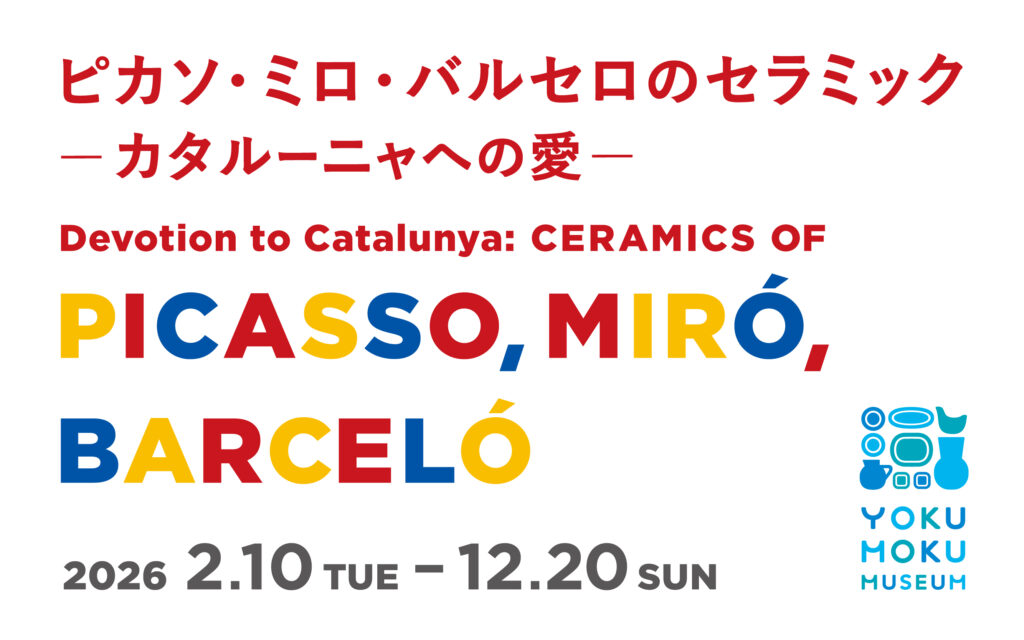
Exhibition title: Devotion to Catalunya: Ceramics of Picasso, Miró, Barceló
Supervision: Kenji Matsuda, Professor, Keio University
Venue/Organizer: YOKU MOKU MUSEUM (6-15-1 Minami Aoyama, Minato-ku, Tokyo)
Exhibition Period: 2/10/2026 (Tues) – 12/20/2026 (Sun)
Closed: Mondays (or if a holiday falls on a Monday, the following Tuesday), year-end and New Year’s holiday period, and exhibition-installation periods
Opening Hours: 10:00 a.m. to 5:00 p.m. (last admission 30 minutes prior to closing time)
Supported by: Embassy of Spain in Japan/Instituto Cervantes Tokio, Minato City Board of Education/Catalan Tourist Board
Special Cooperation: YOKU MOKU Co., Ltd.
Related Events: Commemorative lectures, gallery talks, Picasso de Art learning program, and school collaboration programs will be held in conjunction with this exhibition throughout the exhibition period. Up to date information to be posted on the official website.
Admission Fee (tax included)
Ordinary ticket ¥1,400
University Students ¥1,000 (high school students and younger free with school ID)
※a visitor presenting a disabled identification card may enter free of charge along with one accompanying person.
Group discounts are available; please inquire for conditions.
Concurrent Exhibition (included with admission ticket)
Yoku Moku Collection 2026 (Permanent collection)
Exhibition Overview
Yoku Moku Museum’s Devotion to Catalunya: Ceramics of Picasso, Miró, Barceló, an exhibition curated by Spanish art scholar Kenji Matsuda, focuses on ceramic works by three of Spain’s most celebrated 20th century artists, exploring their individual expression of deep connections to Catalonia.
Catalonia, an autonomous region bordering the Mediterranean Sea in northeastern Spain, has a history of continuously pursuing independence from Spain, even in the harsh conditions of the Spanish Civil War and cultural suppression under the dictatorship of Francisco Franco. Pablo Picasso (1881-1973) moved from Málaga to Barcelona, the capital of Catalonia, with his family at the age of 14 and his formative years were spent in the heart of the avant-garde Catalan Modernisme art movement. Later, as an aspiring young artist, Picasso relocated from Barcelona to Paris, capital of the art world at the time. Even in self-imposed exile during the Spanish Civil War, Picasso continued to support Catalonia, his adoptive home. The depth of his attachment to Catalonia is powerfully demonstrated by his donation of works (through friends in the city) to Barcelona, particularly in the 1950s, followed by the establishment and his subsequent bequest, carried out by his wife Jacqueline, to the Picasso Museum Barcelona.
Joan Miró (1893-1983) is another artist profoundly drawn to Catalonia. His impression of what seemed to him a primal landscape when convalescing at the age of 18 in the rural village of Montróg in Catalonia’s Tarragona province, remained in his heart. Miró who had fled to Paris at the outbreak of the Spanish Civil War later returned, via Mallorca, to Montróg where he continued to base himself. He began creating sculptures in the 1950s. Encounters with sculptor Josep Llorens Artigas and his son Joan Gardy Artigas (Joanet) led to numerous collaborative ceramic and bronze works, many of which were cast at the Parellada foundry in Barcelona. Likely aware of expressive differences that emerged from different locations, Miró used multiple foundries for his sculptures. More than simply the land where he was born, Catalonia for Miró undoubtedly was a special region where he felt protected and at ease.
Miquel Barceló (1957 – ), a leading contemporary Spanish artist who ranks in the lineage of Picasso and Miró. Originally from Felanitx, a Catalan-speaking town on the island of Mallorca, he had a deep cultural and regional connection with Miró who settled on the island in his later years. Picasso and Miró remain Barceló’s revered mentors. Influenced by the scenery and atmosphere of Mallorca, Catalonia, the locus of his work, as well as the broader Mediterranean and as lands as diverse as Africa and the Himalayas and beyond, Barceló continues to question the very meaning of what it is to be human on planet earth. The Miquel Barceló Exhibition, his first retrospective exhibition in Japan, toured Tokyo Nagasaki and Mie, starting in 2021. It led to a collaboration in 2023 with local Shigaraki ware artist Furuya Kazuya (1976 – ) in Shigaraki, Shiga Prefecture. The ceramics Barceló created in Shigaraki, clearly imbued with fresh inspiration from the surroundings, have a feel and quality distinct from works he produced previously in Spain.
A common affinity with Catalonia links the expressions in ceramics of the three distinctive Spanish artists — Picasso, Miró, and Barceló. The exhibition marks the public debut of Miquel Barceló’s Shigaraki ceramic works. The Yoku Moku Museum is also featuring works on loan from other Japanese museums for the first time. Viewers will experience the distinctive approaches of the three celebrated Spanish artists through the lens of their ceramic works and their shared connection and attachment to Catalonia.
Chapter 1 Pablo Picasso’s Ceramics and Catalonia
Because of his opposition to the regime of General Francisco Franco, Picasso chose to live in exile in France when the Spanish Civil War broke out. While never directly cooperating with the Spanish Republicans, he liberally supported Barcelona, the city of his youth, and his friends who lived there. The 1955 The Pioneers of Art Movements exhibition in Barcelona presented ceramic works by Picasso from the collection of his friend, sculptor Manolo Hugué. This section displays works from the Yoku Moku Museum’s collection that are of the same editions and types as those in the Manolo Collection now housed at the Barcelona Picasso Museum, as well as 16 ceramic works Picasso himself donated to the city of Barcelona in 1957, and edition ceramics donated in 1982 by Picasso’s wife, Jacqueline Roque, to the Barcelona Picasso Museum. Also exhibited are official documents from the time and materials from the Gaspar Gallery that were instrumental in the reception of Picasso’s work in post-war Catalonia.
-
 Pablo Picasso, Goat’s head in profile, A.R.145, 1952, YOKU MOKU MUSEUM
 -
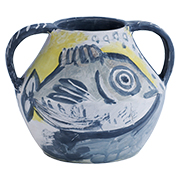 Pablo Picasso, Two-handled Fish Vase, A.R.133, 1951_05_09, YOKU MOKU MUSEUM
 -
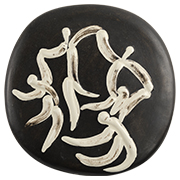 Pablo Picasso, Four Dansers, A.R.313, 1956_02_22, YOKU MOKU MUSEUM
 -
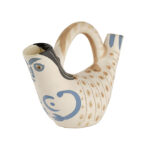 Pablo Picasso, Mermaid, A.R.136, 1952, YOKU MOKU MUSEUM
Chapter 2 Joan Miró’s Ceramics and Catalonia
Joan Miró, who had fled to France to escape the conflict of the Spanish Civil War, returned to Spain to evade the German Occupation of France. Like Picasso, he was a supporter of the Republican government of Spain, and it was difficult for him to freely express himself under the Franco regime. In this context, ceramics became an important medium for him from 1944 when he began to collaborate with his longtime friend ceramist Josep Llorens Artigas. Joan Gardy, Josep’s son, was also an important source of support for Miró’s ceramic production in Catalonia. This section of the exhibition features ceramics jointly created by Miró and Artigas and his son, as well as bronze sculptures by Miró, ceramics by Artigas and his son, and posters that reflect Miró’s connection with Catalonia during this period.
-
-
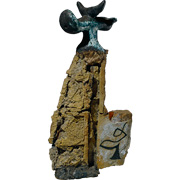 Joan Miró/Josep Llorens Artigas, Project for a Monument, 1956, The National Museum of Modern Art, Kyoto
 -
 Joan Miró/Josep Llorens Artigas, Woman, 1962, The Museum of Contemporary Ceramic Art, the Shigaraki Ceramic Cultural Park
 -
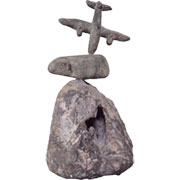 Joan Miró, Personage and Bird, 1966, Asahi Group Oyamazaki Villa Museum of Art
※Limited time exhibition
-
Chapter 3 Miquel Barceló’s Ceramics: Experiments in Shigaraki
Miquel Barceló is acclaimed as a leading contemporary Spanish artist. Japan’s first retrospective of his works, the Miquel Barceló Exhibition, toured in Nagasaki, Mie, and Tokyo in 2021-2022. His visits to Shigaraki in 2022 and 2023 led to collaboration in Shiga Prefecture with local Shigaraki ceramics artist Kazuya Furutani (1976 – ) in 2023. His exhibition at the Yoku Moku Museum marks the first time for Barceló’s ceramic works created in Shigaraki to be displayed at a Japanese museum. Illustrated books, prints, and other related works that point to Barceló’s versatile creative activities are also introduced. Barceló was commissioned to design globally famous soccer club FC Barcelona’s 125th anniversary official poster. The club’s 75th anniversary poster was designed by Joan Miró in 1975. Both posters will be displayed at this exhibition.
-
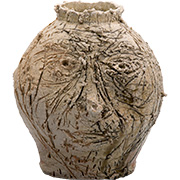 Miquel Barceló, Self-portrait of Shigaraki, 2022, Private collection
 -
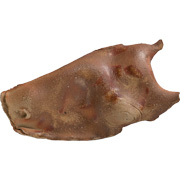 Miquel Barceló, Head Skin, 2023, Private collection
 -
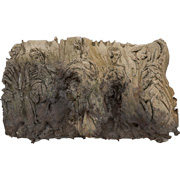 Miquel Barceló, Dance of the Dead, 2023, Private collection
Curator
Kenji Matsuda (Professor, Keio University)
Kenji Matsuda was born in Kumamoto Prefecture. He graduated from the Department of Spanish Studies in Sophia University’s Faculty of Foreign Studies. He completed the doctoral program at Complutense University in Madrid after studying at the Graduate School of Gakushuin University. He is currently a Professor in the Business and Commerce Faculty of Keio University, specializing in Spanish art history. He is co-author of Introduction to Spanish Art History (NHK Books); More About Picasso: Revised Edition and More About Miró (Tokyo Bijutsu); Spain: The Crisis of the 20th Century (Keio University Press); and Collected Works of Dali (Tokyo Bijutsu).